| Grade | Percentage |
|---|---|
| A | [94, 100] |
| A- | [90, 94) |
| B+ | [87, 90) |
| B | [83, 87) |
| B- | [80, 83) |
| C+ | [77, 80) |
| C | [73, 77) |
| C- | [70, 73) |
| D+ | [65, 70) |
| D | [60, 65) |
| F | [0, 60) |
Syllabus
Click here to download the syllabus.
Time and location
| Day and Time | Location | |
|---|---|---|
| Lectures | Tu & Th 2:00 - 3:15 PM | Cudahy Hall 120 |
| Office hours | Tu & Th 3:20 - 4:20 PM; Wed 2 - 3 PM | Cudahy Hall 353 |
Office Hours
My in-person office hours are TuTh 3:30 - 4:30 PM, and Wed 2 - 3 PM in Cudahy Hall room 353.
You are welcome to schedule an online meeting via Microsoft Teams if you need/prefer.
Learning objectives
By the end of the semester, you will be able to…
- Represent and manipulate data in effective ways
- Manipulate data using packages/tools and by ad hoc data handling
- Use mathematical, computational and statistical tools to detect patterns and model performance
- Use computational principles and tools to tackle issues addressable by data science
- Use a solid foundation in data science to independently learn new methodologies and technologies in the field of data science
Prerequisites
COSC 1010 (Intro to Programming) and MATH 4720 (Intro to Statistics), or MATH 2780 (Intro to Regression and Classification).
Programming experience is helpful because the course involves doing regression analysis using programming language.
The course will also assume facility with using the internet and a personal computer/laptop. The course involves coding in R and Python using Posit Cloud, a cloud integrated development environment (IDE).
Talk to me if you are not sure whether or not this is the right course for you.
Course Management
All course materials are posted on our course website https://math3570-s26.github.io/website/.
Course grades are saved and managed in D2L > Assessments > Grades.
Textbooks
There is no required textbook for this course. Course materials will consist of Dr. Yu’s slides, lab notebooks, and online references.
Below are useful references for deeper study.
(r4ds) R for Data Science (2e) by Hadley Wickham, Mine Çetinkaya-Rundel, and Garrett Grolemund.
(tmr) Tidy Modeling with R by Max Kuhn and Julia Silge.
(py4da) Python for Data Analysis (3e) by Wes McKinney.
(IS) Introduction to Statistics by Cheng-Han Yu. (Good resource for brushing up your basic probability, statistics and simple linear regression knowledge.)
E-mail Policy
I will attempt to reply your email quickly, at least within 24 hours.
Expect a reply on Monday if you send a question during weekends. If you do not receive a response from me within two days, re-send your question/comment in case there was a “mix-up” with email communication (Hope this won’t happen!).
Please start your subject line with [math3570] or [cosc3570] followed by a clear description of your question. See an example below.
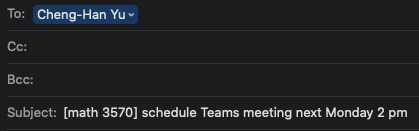
Email etiquette is important. Please read this article to learn more about email etiquette.
I am more than happy to answer your questions about this course or data science/statistics in general. However, with tons of email messages everyday, I may choose NOT to respond to students’ e-mail if
The student could answer his/her own inquiry by reading the syllabus or information on the course website or D2L.
The student is asking for an extra credit opportunity. The answer is “no”.
The student is requesting an extension on homework. The answer is “no”.
The student is asking for a grade to be raised for no legitimate reason. The answer is “no”.
The student is sending an email with no etiquette.
Grading Policy
Your grade is from the following categories and distribution
25% In-class lab activities
10% AI activities
45% Mini projects
20% Final project competition
You have to participate (in-person) in the final presentation to pass the course.
There will be no individualized extra credit homework/project/exercise/exam to compensate for a poor grade. All students have the same opportunities to succeed. Class participation may be used for grade adjustments at the end of the semester.
The final grade is based on the grade-percentage conversion Table 1 on the next page. \([x, y)\) means greater than or equal to \(x\) and less than \(y\). For example, 94.1 is in \([94, 100]\) and the grade is A and 93.8 is in \([90, 94)\) and the grade is A-.
Lab activities
In-class labs are short activities that you complete during class, often in small groups. They are usually graded as complete or incomplete.
In class labs are used as evidence of both attendance and participation.
You may have up to two missing or incomplete labs without penalty.
For each additional missing or incomplete lab, 2% points will be deducted from your final course percentage.
- You must follow the generative AI policy described below.
Midterm mini projects
You will work in a team on 3 midterm mini projects.
This project will focus on a subset of the course content up to that point, for example data wrangling and visualization or a simple predictive model.
The mini projects will include
- A documented GitHub repository.
- A Quarto report describing your question, data, methods, and findings.
- A short in-class group presentation.
- An AI usage documents that shows how you used generative AI and how you verified any AI generated content.
More detailed instructions and rubric will be provided later in the semester.
Final project competition
The final project is a team based competition. Each team will choose one of the following directions or a related idea approved by the instructor.
A data analysis project using statistical models or machine learning algorithms.
A tutorial style project that introduces an R or Python package not covered in class, including a live demo.
A project that introduces and demonstrates a (AI) data science tool for visualization, computing, or workflow that was not used in class, including a live demo.
A project that introduces another programming language for data science, for example Julia, SQL, MATLAB, or SAS, with a live demo.
A web development project such as a Shiny app or dashboard with a live demo.
You must complete the final project and be present for the presentation to pass this course.
Each project must include an AI usage appendix that documents prompts, outputs, and team decisions about what to trust, modify, or reject.
The final project presentation is on Thursday, May 1, 2 PM and Monday, May 5, 10:30 AM - 12:30 PM.
Generative Artificial Intelligence (GenAI) Policy
You are responsible for the content of all work submitted for this course.
For your homework, take-home exams, and project, you are allowed to use generative AI tools such as ChatGPT to generate a draft of text of your work.
To avoid any academic integrity issue, you must cite your AI usage, or screenshot your entire AI usage history. Check the followings on how to cite it.
If you use GenAI, please include the followings in your submitted work:
- How I used AI (prompts or questions)
- Generated output (screenshot or copy-paste excerpt)
- How I used the output
Here is an example.
- How I used AI (prompts and questions)
- I asked ChatGPT to generate a histogram using R.
- Generated output (screenshot or copy-paste excerpt)
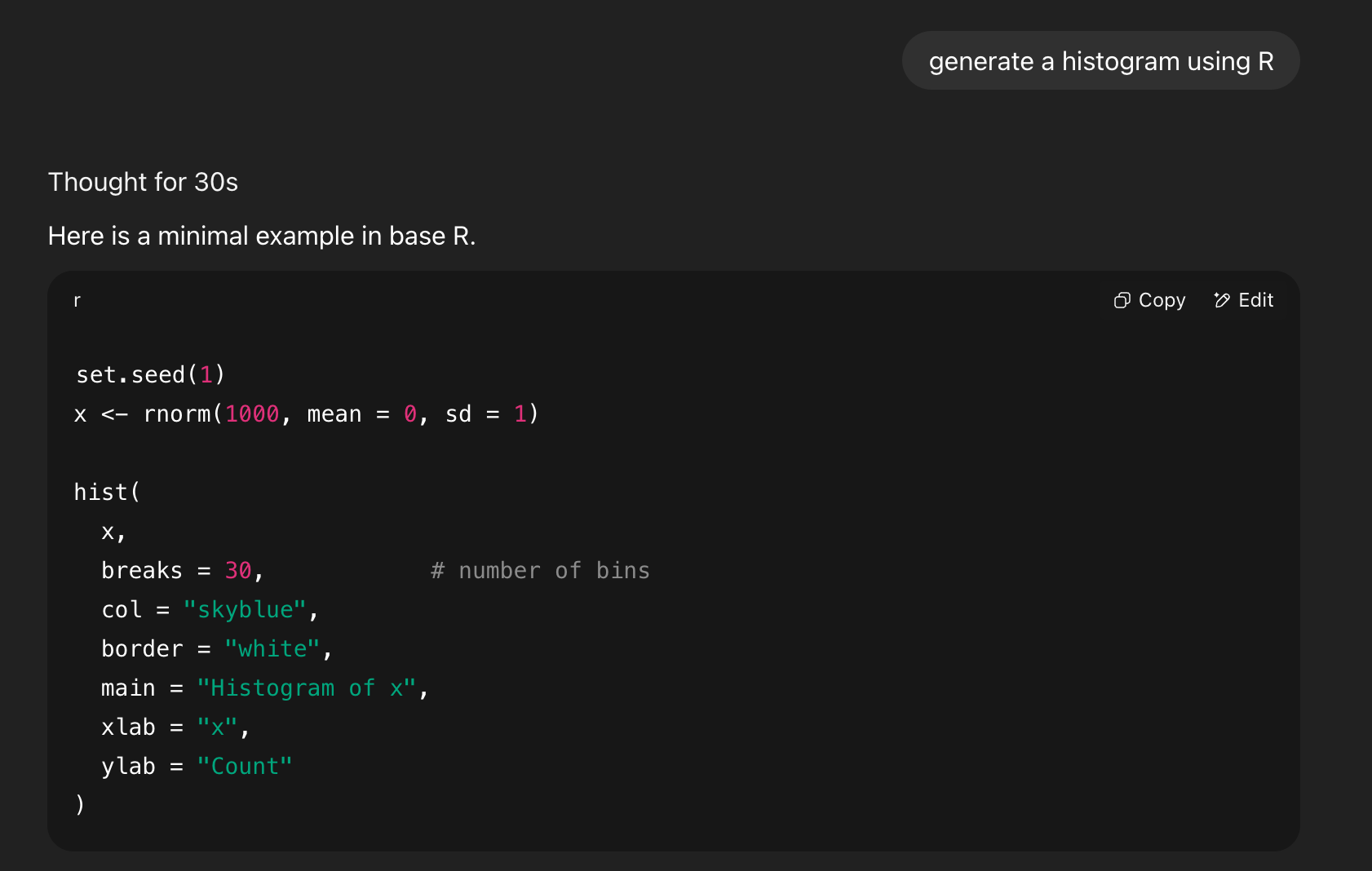
- How I used the output
- I reviewed the suggestions, but I did not use the exact code. Instead, I change the code format and breaks value to 50.
Academic Integrity
Watch this video about academic integrity issue of using GenAI.
This course expects all students to follow University and College statements on academic integrity.
Honor Pledge and Honor Code: I recognize the importance of personal integrity in all aspects of life and work. I commit myself to truthfulness, honor, and responsibility, by which I earn the respect of others. I support the development of good character, and commit myself to uphold the highest standards of academic integrity as an important aspect of personal integrity. My commitment obliges me to conduct myself according to the Marquette University Honor Code.
Accommodation
If you need to request accommodations, or modify existing accommodations that address disability-related needs, please contact Disability Service.
Important dates
- Jan 20: Last day to add/swap/drop
- Mar 8-14: Spring break
- Mar 10: Midterm grade submission
- Apr 2-6: Easter break
- Apr 10: Withdrawal deadline
- May 2: Last day of class
- May 4: Final project presentation
- May 12: Final grade submission
Click here for the full Marquette academic calendar.
Dr. Yu reserves the right to make changes to the syllabus.